> For the complete documentation index, see [llms.txt](https://wiki.cdn-perfprod.com/llms.txt). Markdown versions of documentation pages are available by appending `.md` to page URLs; this page is available as [Markdown](https://wiki.cdn-perfprod.com/guides/extension/adding-a-proxy.md).
# Adding a proxy
Learn how to add a proxy server to the extension and a quick overview to the different proxy methods.
{% hint style="info" %}
**Info:** by default, the extension has some proxies pre-defined and you don't need to host your own if you don't like. This has been explained more in detail at the following link: [Proxy information](/must-read/proxy-information.md).
{% endhint %}
## :computer: How to add a proxy server to the extension
***
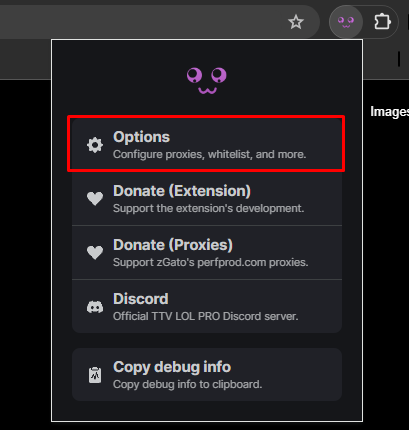
We need to access the Extension's options page, to do so: click on the extension's icon (located at the puzzle icon) and click on **Options.**
Now in the extension's options page you'll see a Proxies tab in which you'll be able to add proxies to the Proxy ad requests segment or the Proxy all requests segment. Primary proxies are priorized over fallback, and fallback proxies are only used if the proxy above it fails to respond to a request (is down).
{% hint style="success" %}
**Proxy ad requests:** will optimize and only proxy what's strictly needed to avoid Twitch's ads. This method will reduce significatively the bandwidth usage on the server's end.
{% endhint %}
{% hint style="warning" %}
**Proxy all requests:** will just proxy all required requests all the time without analyzing which ones are needed or not to avoid the ads. This method does use more bandwidth than Proxy ad requests but can be considered more reliable.
{% endhint %}
In the following example image you'll see that the Proxy ad requests option is enabled and there's 2 proxies added. This means that by default it will proxy to the first one (beta.eu) and alternatively, if the first one is down, it will proxy to the next one (eu).
The proxy all requests option which is currently disabled does in reverse because I added them like that.
For more advanced settings please go to the following page:
{% content-ref url="/pages/XR7FibWLqfBrnLUd1gSg" %}
[Options page](/advanced/options-page.md)
{% endcontent-ref %}